8 min read
Birthday Reminder App vs Calendar: Which One Is Better?
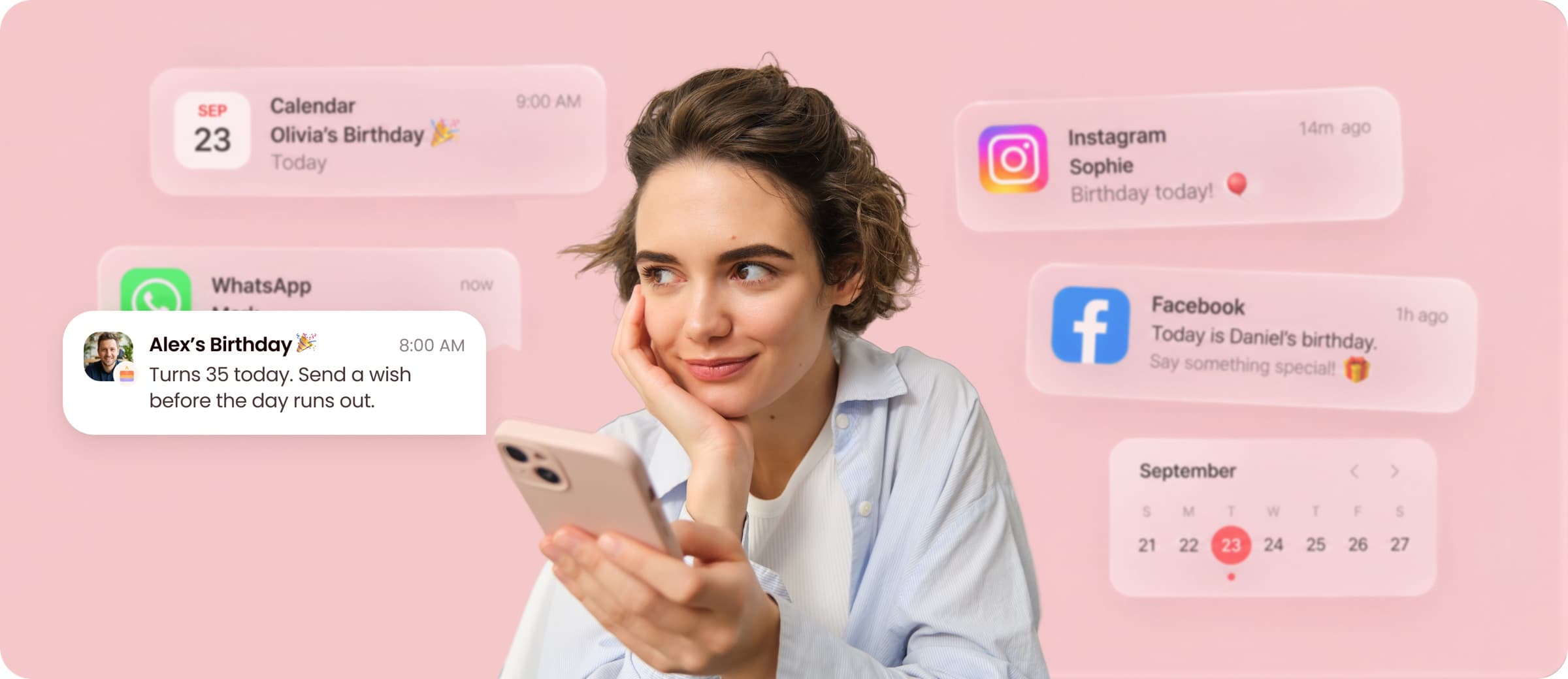
Both can store a date. A calendar organizes your time; a birthday reminder app organizes the people who matter.
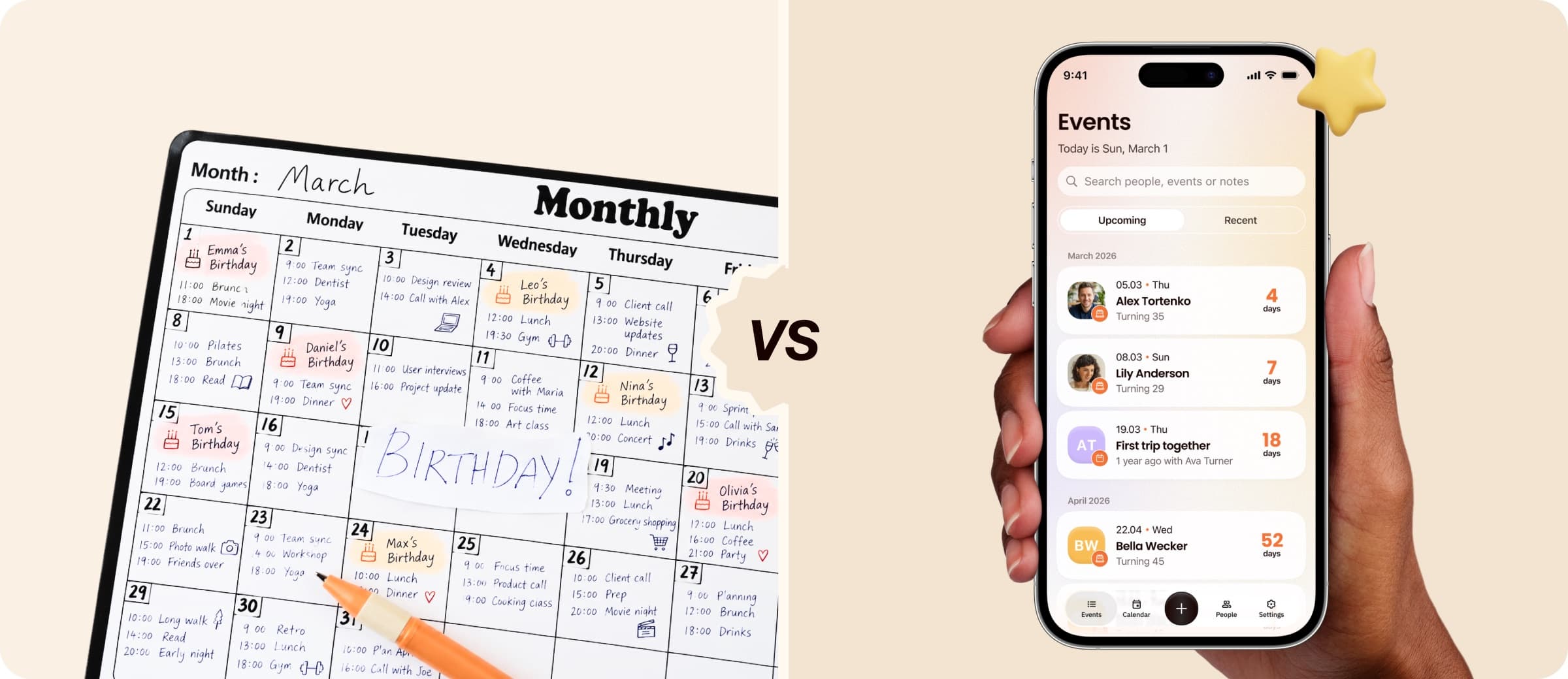
A calendar is one of the simplest ways to keep track of important dates. You can add a friend’s birthday, an anniversary, a meeting, a work deadline, a doctor’s appointment, or a bill payment reminder. Everything is in one place, and at first glance, it may seem that a separate birthday app is simply unnecessary.
But the more events appear in your calendar, the harder it becomes to notice personal dates among them.
Work meetings, study sessions, calls, deadlines, trips, and dozens of other tasks fill up day after day. A close friend’s birthday may be entered correctly and even have a reminder, but it can still look like just another item among many other events.
This is where the difference between a regular calendar and a dedicated birthday reminder app becomes clear. Both tools can store a date, but they organize information differently.
A calendar mainly answers the question: “What do I have scheduled?”
A birthday reminder app focuses more on another question: “Which important person in my life has a special date coming up?”
So the choice between a calendar and a birthday reminder app is not about which tool is “better” overall. It depends on the task you need to solve.
What Does a Regular Calendar Do Well?
A regular calendar is excellent for planning time.
In one place, you can see work meetings, classes, calls, trips, appointments, deadlines, and personal events. If you need to understand what is happening today, tomorrow, or during the next week, a calendar gives you a very convenient overview.
For a small number of personal dates, this is often completely enough.
For example, if you only need to remember a few birthdays of close family members, you can add them as recurring annual events and set reminders.
A calendar is also convenient when a personal date is directly connected to a specific plan. If a dinner, trip, or meeting is already planned for someone’s birthday, it makes sense to see it next to the other events scheduled for that day.
So the problem is not that regular calendars work poorly.
On the contrary, they perform their main function very well — helping you manage your schedule. But because calendars are universal tools, personal dates can receive the same level of attention as dozens of other entries.
When Does a Calendar Become Less Convenient for Birthdays?
Imagine a typical work week.
On Monday, you have two meetings. Tuesday has a deadline. Wednesday includes a doctor’s appointment and a call. On Thursday, you need to pay a bill. Friday has several more meetings.
Somewhere among all of that is a friend’s birthday.
Technically, the date is in the calendar. But visually, it competes with everything else.
The situation becomes even more complicated if you need to remember not five, but twenty, thirty, or more personal dates. Birthdays of family members are joined by friends, colleagues, acquaintances, partners, and other important people.
The calendar gradually turns into a large list of completely different types of events.
There is another important difference. A calendar is usually organized around time, not around people.
When you open a particular day, you see what is scheduled for that date. But if you want to quickly check everyone whose birthday is coming up next month, or review all personal events connected to a specific person, a regular calendar may be less convenient.
The date is stored correctly, but the context around it is limited.
That is why people who actively use a calendar for work and everyday planning may find it useful to have a separate space for personal dates.
What Makes a Birthday Reminder App Different?
A birthday reminder app follows a different logic.
Instead of mixing birthdays with every possible type of event, it focuses specifically on people, personal dates, and reminders.
This changes the way information is presented.
The focus is not a particular day on the calendar, but the person and the events connected to them. You can quickly see whose birthday is coming up, which important dates are approaching, and when you may want to start preparing for them.
This format is especially useful if the goal is not only to avoid the situation of “I forgot to send a birthday message,” but also to see the date in advance.
For example, a reminder on the birthday itself may be enough to help you send a quick message. But if you want to buy a gift, arrange delivery, or plan a meeting, it is much more useful to know about the event one or two weeks earlier.
A dedicated birthday tracker also makes it possible to keep personal dates separate from work tasks.
As a result, a birthday does not compete on the screen with a deadline, video call, or grocery reminder. It appears among other events with the same personal context.
Calendar vs Birthday Reminder App: What Is the Main Difference?
The main difference is not whether the tool can store a date. Both can do that.
The difference is in how the information is organized.
A calendar is focused on your schedule. It helps answer the question of what is happening on a particular day or at a particular time.
A birthday reminder app is focused on people and personal events. It helps you see who has an important date coming up and what you need to remember about that person.
A calendar may be better when you want to see a birthday in the context of your full daily schedule.
For example:
A personal date app is more useful when you want to see a different kind of context:
One format does not replace the other.
Instead, they can solve different tasks: a calendar helps manage time, while a birthday tracker helps keep important people and events from disappearing among everything else.
When Is a Regular Calendar Enough?
A separate birthday reminder app is not necessary for everyone.
If you only track a small number of personal dates, a calendar may completely cover your needs.
For example, a regular calendar will probably be enough if you:
- track only a few birthdays;
- check your calendar regularly;
- do not have a large number of work and personal events;
- use simple reminders;
- do not need additional context about people. In that situation, adding another tool just for a few dates may genuinely be unnecessary.
The goal is not to use as many apps as possible, but to find a system that actually works.
If you always notice birthdays in your calendar and receive reminders early enough, there is no reason to change your approach simply because a specialized tool exists.
When Does a Dedicated Birthday Reminder App Make More Sense?
The situation changes when the number of important people and dates grows.
If your calendar is heavily used for work, study, meetings, and everyday tasks, personal events can easily get lost among the rest of the information.
A dedicated app may be more useful if you want a separate list of people, a clear view of upcoming birthdays, and other important dates without work-related noise.
This is especially relevant if you need reminders in advance.
For example, one person may only need a simple notification one day before their birthday. For someone else, you may want to buy a gift a week in advance. And for an important anniversary, you may need even more preparation time.
In this kind of system, the focus shifts from the calendar date itself to what the date means and who it is connected to.
That is one of the main reasons to use a dedicated birthday reminder app: not to replace your calendar, but to separate personal events from the general flow of tasks.
How Does Torte Keep Personal Dates Separate?
Torte uses this people-first approach.
Instead of adding birthdays to the same general list as work meetings, deadlines, and other calendar events, the app lets you keep important people and the dates connected to them in a separate space.
In the people list, you can see the contacts whose important dates you are tracking. Upcoming events help you quickly understand what is coming next, while Calendar View lets you browse personal events in a more familiar calendar format.
At the same time, the context stays personal: the calendar inside Torte is not filled with work meetings, deadlines, or everyday tasks.
You can also use reminders for events, so you are not limited to receiving a notification only on the day itself.
This matters because remembering a date and being ready for it are not always the same thing.
If you only want to send a short birthday message, a same-day reminder may be enough. If you need to prepare a gift or plan a meeting, an earlier reminder gives you time to do that.
Torte also is not limited to birthdays. You can add other personal events to a person, so important dates remain connected to the individual rather than existing as isolated entries among hundreds of calendar events.
As a result, Torte is not trying to replace a regular calendar.
Its purpose is different: to create a separate place for the people and dates you do not want to lose among work, tasks, and the rest of your daily schedule.
So Which Is Better: a Calendar or a Birthday Reminder App?
There is no universal answer.
If you only need to remember a few dates and your calendar is not overloaded with other events, a regular calendar may be completely sufficient.
But if you track many personal dates, actively use your calendar for work and everyday tasks, and birthdays regularly disappear among other events, a dedicated birthday reminder app may be more convenient.
The main difference is focus.
A calendar helps you manage time.
A dedicated birthday tracker helps you remember people.
Sometimes these two tasks fit perfectly well into one tool. In other cases, it is much easier to separate them and keep personal dates in their own space.
What matters is not where the birthday is stored. What matters is whether your system helps you notice it in time — before an important date gets lost among meetings, deadlines, and everyday tasks.